


The Crackle Technique
Getting crackles in your enamel depends on the use of two layers of enamels which have different coefficients of expansion. This technique is extensively covered in the Thompson Enamel Workbook.
Copper and silver are the only bases on which the Thompson enamels produce crackles. (The special enamels, formerly produced for use on aluminium are no longer in production so we need not discuss crackle techniques on aluminium here.)
We start by applying a base coat of an enamel which has a relatively low expansion coefficient. The Thompson numbers # 1006 (opaque white), # 1020 (titanium white), # 1997 (crackle base black) and # 2008 (flux) are suitable choices. We apply these base coats in the usual manner. After firing, we apply a top coat which consists of enamels with a slightly higher coefficient of expansion. These we find in the series 'liquid enamel colours'. These are available in a large number of colours which may be mixed to produce many other colours. They may also be mixed with ceramic pigments, but it is advisable to use only small quantities of the latter. How much to use is a matter of experimenting a bit.
These liquid enamel colours are mixed with water to a thickness of yoghurt and then painted onto the enamelled base coat.* When the second coat is totally dry, we fire the piece a second time, and when the work is taken from the kiln, the crackle pattern will be visible.
The crackle pattern will slightly differ if we change the thickness of either the top coat or the base coat. Changing the firing time or the kiln temperature also has effect on the pattern of the crackles. I fired my work at temperatures of 780°C (appr. 1450°F) and got very good results.
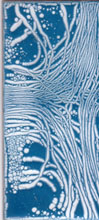
My advice to you is, to start by running some experiments. I myself prefer to clean and anneal several small pieces of copper and work in series in which I take care to keep most factors (temperature, thickness of the base coat, thickness of the top layer, firing time) constant while - one by one - I change the other factors.
To explain this a bit more explicitly, I give an example:
While firing at a constant temperature of 780°C, firing for the same length of time (2 minutes) and using the same top layers, I may vary the base coats (# 2008, # 1006, # 1020, # 1997). Or I may use one base coat of my choice, fire during the same length of time and at the same temperature, while changing the thickness of either base coat or top layer. The first experiment will give an indication of the colour combinations after firing which is important when we have to decide on the colour of our crackle pattern, the second experiment will show the various changes in pattern (thick lines, thin lines, many or few lines etcetera).
All these experiments will be of little help if we do not make extensive notes of the procedure. So keep your note book and pencil or pen at hand.
* When preparing the liquid enamel colours, use small lidded jars or pots and write the numbers of the colours on it. Especially if you have mixed colours or added ceramic pigments, it is important to know exactly what you have done.